
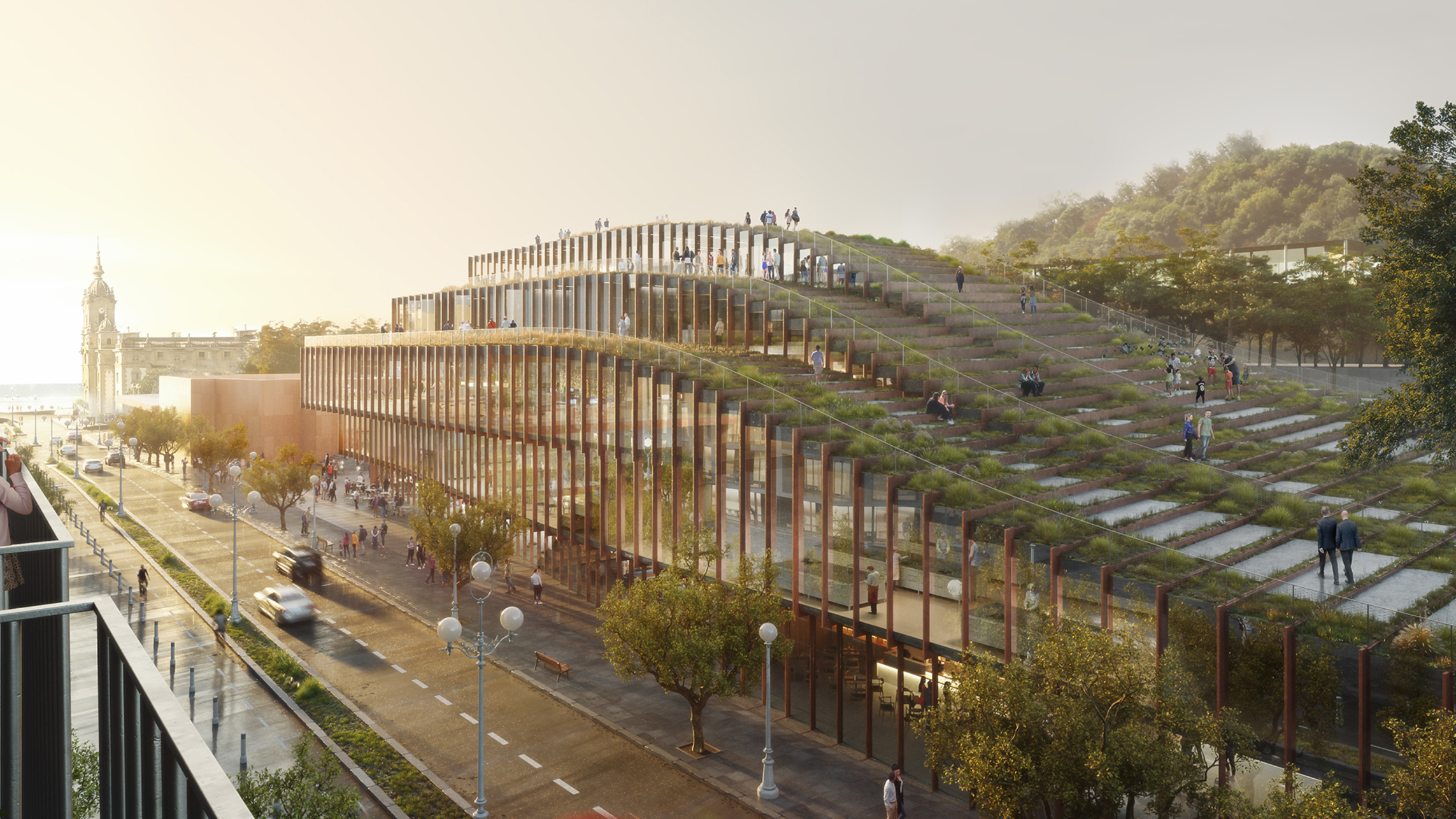
Basque Culinary Center Presents Details of GOe, a Sustainable Strategic Project for the Future of Gastronomy and the Territory
GOe - Gastronomy Open Ecosystem will constitute an open ecosystem based on science and knowledge, addressing and scaling the major challenges of the future in gastronomy and food. It will be built in Donostia-San Sebastián and is one of the strategic projects of Basque Culinary Center, aimed at further solidifying the region's leading role in gastronomy.
During the presentation of GOe's content and activities, Joxe Mari Aizega, director of Basque Culinary Center, reviewed the challenges faced during the establishment of the Basque Culinary Center and its contributions. He highlighted that the organization generated a total economic impact of €32,623,721, consolidating public revenue between 2011 - 2023 at €41,300,000. In other words, for every euro of public money invested, €2.8 was generated. The organization's contribution from an economic and positioning perspective is strong. These results, combined with the need for ongoing innovation and the goal of solidifying the city's international status as a gastronomic reference point, are the foundations of the creation of GOe. The Basque Culinary Center team, along with other stakeholders, has been working on this project for over two years.
GOe will be built in the Gros neighborhood of Donostia-San Sebastián. The temporary transfer of the plot where the new building will be located was approved by the City Council of Donostia-San Sebastián for 75 years. After that period, both the plot and the building will revert to the City Council. During this time, Basque Culinary Center will not be able to carry out any legal transactions with the plot, as its use is solely for the agreed-upon purpose. The transferred plot covers 3,800 m² within an urban area of 24,250 m² that has been reorganized. Over nearly two years of project-related procedures, the working team has managed 22 technical reports from various municipal, regional, and autonomous departments, rigorously complying with all administrative and technical requirements.
From the outset of the project, the circumstances and environmental conditions have been taken into account. Sustainability and respecting the green footprint have been essential elements in the design competition for the building. The winning project from the BIG architecture studio, led by architect Bjarke Ingels, represents an example of sustainability and adaptation to the terrain while maintaining all current social and recreational uses. The project ensures that the green footprint of the new building will be practically the same as the current one.
Content and Activities of GOe
During his presentation, Asier Alea, Director of Global Development at Basque Culinary Center, emphasized that GOe originated from the need to create new specialized spaces that promote and foster innovation. These spaces will encourage the convergence of different stakeholders to conduct collaborative advanced research and innovation. Entrepreneurs, researchers, companies, students, and citizens will be the "inhabitants" of GOe, and their coexistence will result in technologies that address the gastronomy of the future. Currently, food accounts for 20% of our carbon footprint and represents one of the major challenges related to climate change. There is currently no innovation center from a sensory and research perspective in this field.
"Begoña Rodríguez, Director of BCC Innovation, the Technological Research Center in Gastronomy at Basque Culinary Center, highlighted the concepts of "open innovation" and "citizen science." She stated that the paradigm of innovation has changed, requiring active participation from citizens. The building's proximity to people will facilitate more active and natural participation in these projects, which will benefit the participants the most. The projects will be developed in areas such as health, sustainability, digitization, sensory perception, and new products.
GOe 2030 Scenario - Activity Indicators Projection
- Alliances with leading international companies related to major food challenges: 10
- Number of external companies, entrepreneurs, and researchers: 170
- Number of startups generated and/or incubated: 30
- Number of accelerated startups: 150
- New Master's programs: 7
- Professional-oriented training (courses, workshops, etc.): 15
- Number of postgraduate students: 300 (60% international)
- Number of ongoing theses (by 2030): 30
- Number of defended theses (accumulated): 10
- Number of faculty members: 60
- Innovation and research projects: over 800 projects (30% international)
- Scientific publications: over 50 articles
- Patents: 10
- Creation of new spin-offs: 15
- Co-creation and experimentation initiatives with citizens (living lab): 25
Landscape Project
Iñigo Segurola, a landscape designer at Lur Paisajistak, has developed the landscape project for GOe with the goal of maintaining the current green footprint. An inventory of the current vegetation has been carried out to propose a project that preserves this footprint.
The technical report identifies 15 trees, of which 80% are planned to be transplanted, and 73 shrubs in various states of conservation, including some that are not viable for growth. Therefore, in collaboration with the City Council of Donostia-San Sebastián, the precise location of the transplanted trees will be determined, prioritizing adjacent areas. Additionally, the project includes reforestation of open spaces with varieties that respect the site's constraints, strengthening its commitment to sustainability.
The next milestones in the development of GOE will be, in terms of construction, the awarding of the construction contract in mid-October and the start of construction in mid-November, as pointed out by Aizega. An open information meeting on the construction process of GOe will be held to address construction-related aspects, and a permanent information office will be established for citizens to ask questions. Construction of GOe will be completed by the end of April 2025, at which point its activities will commence.
In parallel, work is underway on the project's content, partnerships, talent attraction programs for researchers, innovators, and entrepreneurs. Starting in October, a series of citizen participation sessions will be held to define topics of interest that can be incorporated into the building and projects and activities.
Five Questions, Five Answers
Aizega concluded his presentation by highlighting five concerns related to the project.
Firstly, clarifying the nature of Basque Culinary Center, as it is not a private company but rather a non-profit foundation declared of public utility. The Foundation is supported by three public institutions (City Council of Donostia, Gipuzkoa Provincial Council, and Basque Government), private companies, chefs, a university (Mondragon Unibertsitatea), and a technological center. Additionally, the Basque Culinary Center Foundation is integrated into the Basque public sector, subject to the Public Sector Contracts Act and the control regime of the Basque Government. Therefore, it has characteristics closer to the public sector than the private sector.
Regarding questions related to the concept of a "windfall," Joxe Mari Aizega reiterated that Basque Culinary Center is a non-profit foundation, so no one profits or gains personal benefits from it. On the contrary, individuals, entities, and corporate patrons contribute to the Foundation's purposes.
Any profits generated are entirely reinvested in the Foundation and its activities. Aizega once again emphasized the temporary transfer of the plot by the City Council and that no legal transactions related to it will be possible.
Another major concern is related to the destruction of green areas in the vicinity. According to the General Urban Planning Plan approved in 2010, the plot where GOe will be constructed has been designated for this use for the past 13 years. The transferred plot covers 3,800 m² within an urban area of 24,250 m² that has been reorganized. The GOe building will maintain all current social and recreational uses, ensuring that the green footprint is practically the same as the current one.
Regarding parking, it should be noted that the entire building will be constructed above ground, and there will be no underground floors. Therefore, there will not be four underground parking levels but instead four spaces for cars and 180 bicycle parking spaces.
Concerning the destruction of trees on the plot, Aizega stated, "The conservation of tree species in the area has been one of our fundamental concerns." The technical report identifies 15 trees, of which 80% are planned to be transplanted, and as mentioned earlier, 73 shrubs. Additionally, reforestation with a landscaping project will ensure the preservation of the entire green footprint.
GOe represents a project that combines a passion for gastronomy with talent, research, innovation, and entrepreneurship. It is an ecosystem of innovation and talent attraction at the international level, where key global players will interact in a unique multidisciplinary proposal.