
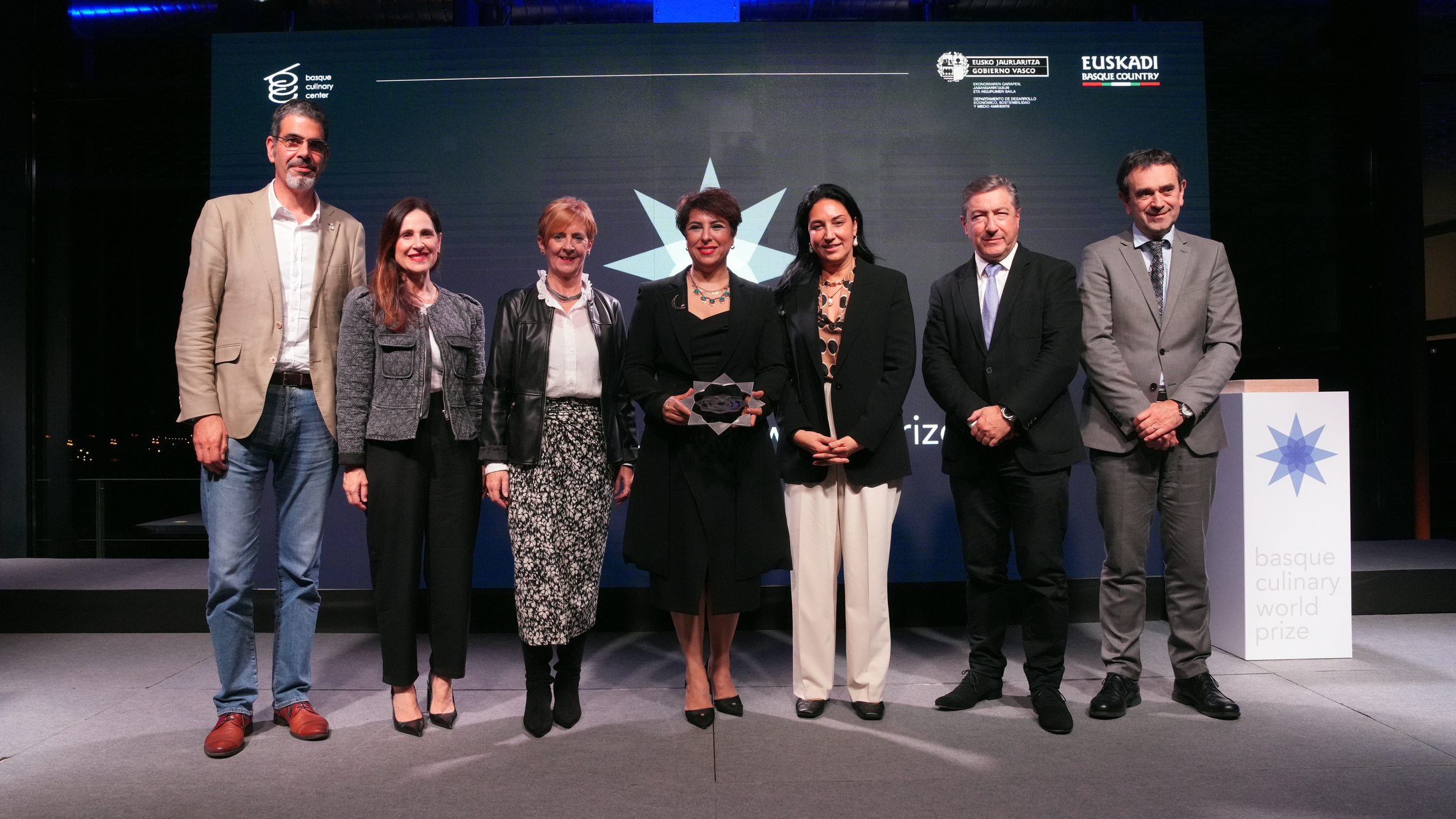
Ebru Baybara has been awarded the Basque Culinary World Prize, 2023
On the evening of the 16th (at 6:30 PM), the Tabakalera Prism in Donostia-San Sebastián hosted the award ceremony for the 2023 Basque Culinary World Prize, honoring Turkish chef Ebru Baybara. Through gastronomy, she has contributed to cultural integration in Mardin, near the Syrian border, focusing on social development and biodiversity. Over two decades, she has been involved in initiatives addressing the migrant crisis in the region, soil revitalization against climate change, and humanitarian assistance for tragedies such as the earthquake in Turkey in February 2023.
The Basque Culinary World Prize is a unique global award granted by the Basque Government within the framework of the Euskadi-Basque Country comprehensive strategy and the Basque Culinary Center, a leading academic institution in gastronomy. It recognizes chefs with transformative initiatives in innovation, technology, education, environment, health, food industry, and socio-economic development, among others.
In the presence of authorities and prominent figures from Euskadi's food sector, the Basque Government's Minister for Economic Development, Sustainability, and Environment, Arantxa Tapia, will present the award, valued at 100,000 euros, to Ebru Baybara. The event will also feature Joan Roca, as the President of the Basque Culinary World Prize Jury, and Vicente Atxa, President of the Basque Culinary Center's Board of Trustees.
Baybara has joined initiatives fostering multicultural integration spaces and employment opportunities, especially for refugees and displaced individuals, committing to nurturing understanding and coexistence in a tumultuous region.
The tragic earthquake that struck Syria and Turkey in early February drew global attention. Nine months later, various forms of aid remain urgent. For Ebru Baybara Demir, engaging in humanitarian aid meant providing hot meals to thousands amidst the calamity. For over two decades, the chef diversified ways to make an impact, collaborating with international organizations, local governments, public-private entities, and local cooperatives. In Mardin, she began linking cuisine with tourism and development, encouraging local women to open their own kitchens (in historic homes) to cater to foreigners, creating employment opportunities, and enhancing the tourism offering.
Later, she joined culinary training programs promoted by organizations like UNHCR and FAO, focusing on providing work opportunities for refugees. Currently, she supports From Soil to Plate, an agricultural development cooperative where regional volunteers work to improve the production and consumption of local and ancestral grains like sorgül (in addition to making soaps, jams, crafts, and marketing them online). She also collaborates in managing biodegradable waste for Diyarbakır's farmer markets, aiming to utilize discarded fruits and vegetables to produce agricultural fertilizers.
The 100,000 euro grant from the Basque Culinary World Prize will support the chef's initiatives benefiting people, the environment, and society. In the words of the winner, Ebru Baybara, "winning the 2023 Basque Culinary World Prize, the Nobel Prize of gastronomy, is an indescribable honor. Being recognized as a 'culinary force of nature' by prominent gastronomy experts holds incredible meaning. It represents over two decades of sincere dedication to a profession I deeply appreciate. Receiving this award, not only as a chef but also as a Turkish woman, following the path laid out by Atatürk on the centenary of our Republic, holds great significance for me and my country. Cuisine transcends physical barriers, and it's crucial to acknowledge everyone involved in the food journey, from the land to the plate, something I realized when I first encountered the Basque Culinary World Prize in 2017. I dedicate this award to the women who changed their lives by joining me on this journey; to the future gastronomes in Turkey to inspire them that geography is the most beautiful destiny, and to my family and all my colleagues who share the same philosophy."
Ebru Baybara was selected as the winner by a jury comprised of some of the most influential chefs in the world, representing the International Committee of the Basque Culinary Center. Chaired by chef Joan Roca (Spain - El Celler de Can Roca), it also included other renowned chefs such as Yoshihiro Narisawa (Japan), Michel Bras (France), Gastón Acurio (Peru), Manu Buffara (Brazil), Dominique Crenn (USA), Trine Hahnemann (Denmark), Elena Reygadas (Mexico), Pia León (Peru), Josh Niland (Australia), Narda Lepes (Argentina), and ThiTid Tassanakajohn (Ton) (Thailand).
A Transformative Initiative
The Basque Culinary World Prize was launched in 2016 to showcase how gastronomy can be a transformative force, emphasizing the work of entrepreneurial individuals, both men and women, committed to excellence; innovative and creative people, tenacious but above all, dedicated to their society.
More than 1,200 nominations and nearly 800 nominees from 42 countries have formed the core of analysis for an award embraced by the press as the "Nobel Prize of Gastronomy," supported by internationally renowned academics and experts, including some of the best chefs of our time.
For over a month, industry professionals and institutions nominated chefs worldwide who demonstrate that gastronomy can be a driver of change in areas such as social integration, sustainability, or education, among others. Meanwhile, the Basque Culinary Center activated a team that conducted an exhaustive search and verification process of different profiles.
On June 7, the Basque Culinary World Prize announced Ebru Baybara as the winner of the 2023 Basque Culinary World Prize and also made two special mentions, reiterating its interest in showcasing current challenges and identifying profiles of entrepreneurial chefs committed to excellence, innovation, creativity, and dedication to their community, setting an inspiring and contagious phenomenon that gastronomy represents.
Thus, in addition to Ebru Baybara, the jury recognized the work of two other chefs by awarding special mentions to Nicole Pisani (UK), for revolutionizing the approach to children's food in schools, reforming collective catering services in primary schools to nourish the bodies and minds of children, and to Heidi Bjerkan (Norway), for implementing multiple restaurant models based on circular economy and a gastronomy committed to social reality, integrating small producers, social entrepreneurs, and educators.
In each edition, through the winner and special mentions, the Basque Culinary World Prize aims to convey a message to the international community, highlighting the various areas in which a chef can add value. In this edition, it emphasizes the field of food education, as well as areas of social integration linked to immigration or talent diversification.